
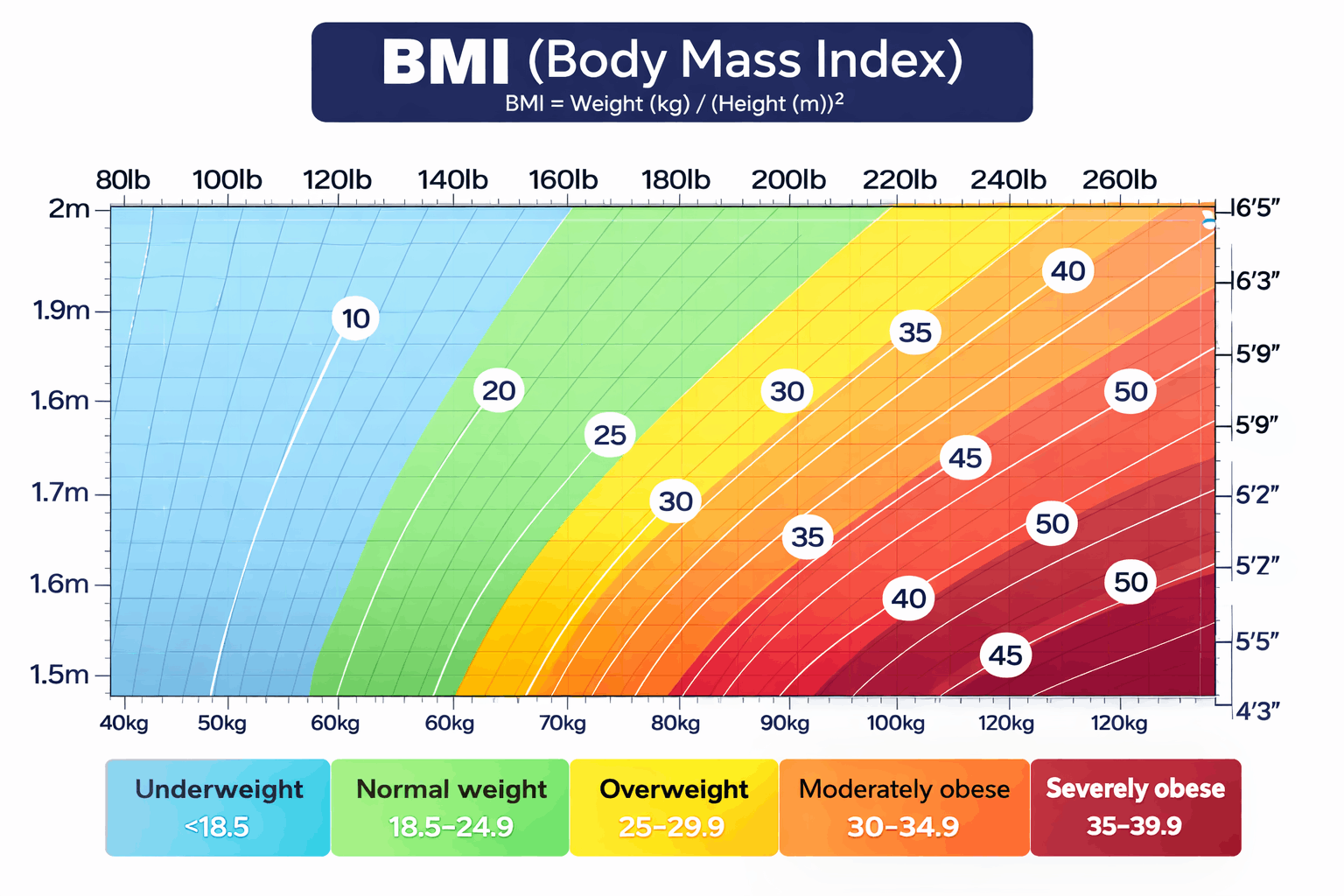
Calculate your Body Mass Index (BMI)
Use this calculator to check your BMI, understand your weight status, and get a clearer view of how your height and weight work together. This tool supports both Metric and US units, and can also display BMI Prime plus an optional Ponderal Index (PI) for deeper insight.
Important: BMI is best used as a quick screening signal — not as a full medical diagnosis. Your age, muscle mass, activity level, body composition, and fat distribution can all affect how a BMI result should be interpreted.
Check Your BMI, Understand Your Weight Range, and Get a Clear Starting Point for Better Health
A strong BMI calculator should do more than show a single number. It should help users understand what their result means, how it is calculated, what range it falls into, and how it fits into a broader picture of health, fitness, and physical readiness. This page is designed to do exactly that.
Whether someone is searching for a BMI calculator female, BMI calculator male, BMI calculator kg, BMI calculator kg with age, BMI calculator kg and feet, BMI calculator female kg, BMI calculator mdcalc, or even BMI calculator calories, the real goal is usually the same: to get a quick, practical, and reliable understanding of body weight in relation to height.
BMI, or Body Mass Index, remains one of the most widely used screening tools for everyday health checks, wellness planning, fitness goals, and even some medical or occupational screening processes. It is simple, fast, and useful, but it should be understood as a screening measure, not a final diagnosis. The best interpretation of BMI comes when it is read alongside factors such as waist size, activity level, body composition, overall fitness, and personal health context.
What Is BMI?
BMI stands for Body Mass Index. It is a simple formula used to compare body weight with height.
For metric units, the formula is:
BMI = weight (kg) ÷ height (m²)
For imperial units, the common formula is:
BMI = [weight (lb) ÷ height (in²)] × 703
BMI is widely used because it is easy to calculate and easy to understand. However, it does not directly measure body fat, muscle mass, bone density, or where fat is stored in the body. That is why a muscular person may have a higher BMI without having excess body fat, while another person with a “normal” BMI may still have an unhealthy fat distribution.
Why People Use a BMI Calculator
People use a BMI calculator for many different reasons. Some want a quick health check. Some want to understand their weight category. Others want to prepare for fitness goals, fat-loss planning, sports readiness, or physically demanding job applications.
A BMI calculator is commonly used to:
- understand your current weight range
- check whether you may be underweight, healthy weight, overweight, or in an obesity range
- support fitness, fat-loss, or wellness planning
- compare your result with standard adult reference categories
- prepare for a medical or occupational screening
- get a starting point before checking waist size or body composition
BMI remains popular because it is simple and widely recognized. Still, the most useful way to read BMI is to combine it with waist measurements, body composition, fitness level, and general health context.
Standard Adult BMI Categories
For most adults, these are the common BMI categories:
| BMI Range | Weight Category | General Meaning |
|---|---|---|
| Below 18.5 | Underweight | Your weight may be lower than the common healthy range for your height |
| 18.5 to 24.9 | Healthy weight | Common reference range for many adults |
| 25.0 to 29.9 | Overweight | Weight is above the common healthy range |
| 30.0 and above | Obesity | Higher weight-related health risk may be present |
These categories are commonly used in public-health and clinical settings, but they are still only part of the picture. A meaningful interpretation of BMI should also consider waist size, body composition, fitness, and medical background.
BMI Health Chart
BMI Chart by Health Meaning
| BMI Zone | What It May Suggest | What Users Often Do Next |
|---|---|---|
| Under 18.5 | Weight may be too low for height | Review diet quality, energy intake, and medical history |
| 18.5–24.9 | Common healthy reference zone | Maintain nutrition, activity, and waist control |
| 25–29.9 | Weight above common healthy range | Check waist size, activity, and body composition |
| 30+ | Higher weight-related health risk | Consider a fuller health review, lifestyle support, and medical advice |
This type of chart makes a BMI page more useful because it turns the calculator into a practical decision-support tool rather than just a number output.
BMI Calculator for Female and Male Users
A BMI calculator female and a BMI calculator male usually use the same adult BMI formula. The actual calculation does not change just because the user is male or female. However, the way a result is interpreted in real life may differ because body composition, fat distribution, and health context can vary from person to person.
That is why many users search terms like BMI calculator female, BMI calculator male, and BMI calculator female kg. They want a result that feels more relevant and more personal. While the BMI number is calculated the same way for adults, it is still wise to read the result alongside age, activity level, waist size, and overall health goals.
BMI Calculator kg, kg with Age, and kg and Feet
Many users search for BMI based on the units they use every day. That is why phrases like BMI calculator kg, BMI calculator kg with age, and BMI calculator kg and feet are so common.
If you use kilograms and metres, BMI is calculated directly using the standard metric formula. If you use kilograms and feet/inches, height usually needs to be converted into metres before BMI is calculated properly. Age may also matter in interpretation. For adults, standard BMI categories are widely used. For children and teenagers, BMI is interpreted differently because age and sex are part of the assessment.
Does Age Matter in BMI?
Yes, but not in the same way for everyone.
For adults, BMI is generally interpreted using standard adult reference ranges. For children and teenagers, BMI should not be judged with adult categories because growth and development matter. In younger age groups, BMI is interpreted using age- and sex-based percentiles instead of the fixed adult cutoffs.
That is why searches like BMI calculator kg with age make sense. People are often looking for a more personalized interpretation, not just a raw number.
What BMI Actually Tells You
BMI does not tell you everything, but it does tell you something useful.
It provides a quick estimate of whether your weight is relatively low, within a commonly healthy range, above that range, or high enough to fall into an obesity category. That can help people decide whether they should pay closer attention to nutrition, physical activity, waist size, and general health habits.
What BMI does not do is directly measure body fat, strength, muscle, endurance, fitness, or overall health status on its own. It works best as a starting point, not the whole story.
What Is a Normal BMI?
For most adults, a normal BMI usually means a BMI in the 18.5 to 24.9 range. Some people also refer to this as the healthy weight range.
That does not mean every person outside that range is automatically unhealthy, and it does not mean everyone inside that range is automatically healthy. It simply means this is the standard reference range commonly used for adults.
BMI Calculator Calories: What Users Usually Mean
Many people search for BMI calculator calories, but BMI and calorie needs are not the same thing.
BMI estimates weight relative to height. Calories relate to how much energy your body uses or needs. A BMI result may help someone think about whether they want to gain, maintain, or lose weight, but it does not directly tell them their ideal daily calorie intake. Calorie needs depend on age, sex, body size, activity level, and personal goals.
When users search for BMI calculator calories, they are often looking for a broader health tool that connects body size, weight range, and practical planning.
BMI Calculator for Job Candidates
Why Job Seekers Search BMI Calculators
A major search intent around BMI comes from candidates applying for physically demanding careers such as police, army, air force, navy, rangers, border security, correctional services, maritime services, aviation roles, emergency response roles, and other operational jobs.
Many applicants want to know whether their weight may affect eligibility before they reach the medical stage. In many real-world recruitment systems, BMI may be used as an early screening measure, but it is often not the only factor. Some agencies combine it with body-fat percentage, waist circumference, waist-to-height ratio, height-weight charts, medical review, or physical performance testing.
International Screening Pattern Seen in Recruitment Pages
| Career Goal | What Candidates Usually Want to Know | Typical BMI Reference Pattern | Broad Screening Pattern |
|---|---|---|---|
| Police jobs | “What BMI is needed for police?” | Usually a healthy-to-moderate range is preferred; often around 18.5–30 as an early screen | Some recruiters use BMI bands, while others allow further review through body-fat or occupational-health assessment |
| Army jobs | “Can I join if my BMI is high?” | Many systems use an initial screening band, often linked to height and weight standards | Height-weight or BMI may come first, followed by body-fat or body-composition review if needed |
| Air force jobs | “Does air force accept high BMI?” | A preferred BMI band may be used first | Some systems shift to body-fat measurement when BMI falls outside the preferred range |
| Navy jobs | “How is body composition checked?” | Often not BMI-only | Height-weight checks, waist or circumference measurement, and body-composition review may all be used |
| Rangers / border force | “What weight standard applies?” | Functional readiness matters more than one universal BMI band | BMI may be used as an early screen, but endurance, medical fitness, and readiness usually matter too |
| Fire service / rescue | “What matters more, BMI or fitness?” | No single global BMI band | Health risk, functional capacity, and job performance are often reviewed together |
| Security / tactical roles | “Will BMI fail me?” | Not universally fixed | BMI may raise a flag, but many employers look deeper at body composition, health risk, and role demands |
Candidate-Friendly Guidance Section
BMI Calculator for Police, Army, Air Force, Navy, Rangers, and Other Uniformed Careers
If you are applying for a physically demanding job, your BMI result can be a useful early indicator, but it should not be treated as the final word. Many employers and agencies look at a bigger picture that may include:
- height and weight screening
- waist circumference or waist-to-height ratio
- body-fat percentage
- mobility and endurance
- cardio fitness tests
- role-specific medical standards
Practical Message for Candidates
A healthy adult BMI range of 18.5 to 24.9 is still the most widely recognized reference point for general health. However, if your BMI is slightly outside that range, that does not automatically mean you are unfit for every role. In many recruitment systems, candidates may still be reviewed through body-fat percentage, waist size, fitness standards, or a broader occupational-health assessment.
Different Ways BMI and Body Readiness Are Assessed Worldwide
To make a BMI page more useful and more original, it helps to show that body readiness is not always judged by BMI alone.
| Method | What It Measures | Why It Matters |
|---|---|---|
| BMI | Weight relative to height | Fast first-step screen |
| Waist-to-height ratio | Abdominal fat relative to height | Helpful because central fat risk matters |
| Waist circumference | Central fat | Common in health and fitness assessment |
| Body-fat percentage | Fat mass relative to total body mass | More useful than BMI for muscular candidates |
| Height-weight charts | Weight against height bands | Common in institutional screening |
| BMI-for-age percentiles | Age- and sex-based interpretation for ages 2–19 | Standard for children and teens, not adult cutoffs |
This broader view gives users a better understanding of how weight, fat distribution, and physical readiness are assessed in real life.
Waist-to-Height Ratio: A Smart Add-On to Your BMI Tool
A strong BMI page becomes even more useful when it includes waist-to-height ratio. BMI gives a first clue, but waist size adds important context, especially when central fat and metabolic risk are considered.
A simple rule many users follow is that your waist should generally be less than half your height.
Waist-to-Height Ratio Guide
| Ratio | General Meaning |
|---|---|
| 0.40–0.49 | Healthy central adiposity |
| 0.50–0.59 | Increased health risk |
| 0.60+ | Further increased health risk |
Adding this measure makes the page feel more practical, modern, and more useful than a basic BMI-only tool.
Important Note About Ethnicity and Risk
BMI is a useful starting point, but health risk is not identical for every person or every population.
Some groups may have a higher cardiometabolic risk at lower BMI levels, which is why BMI should not be treated as a one-size-fits-all judgment. That is another reason waist measures, body composition, and medical context matter.
What Is BMI in Physical Education?
In physical education, BMI is often introduced as a simple way to help students understand the relationship between height and weight. It is commonly used as an educational concept in discussions about health, growth, body awareness, and lifestyle.
However, a good explanation in physical education should also make clear that BMI has limits. It is not a full measure of athletic ability, stamina, strength, or performance.
Why BMI Is Important
BMI matters because it gives users an immediate signal about whether their current weight may deserve closer attention. It is fast, free, familiar, and widely used in healthcare, wellness, and screening.
The most trustworthy way to explain BMI is this: it is useful because it starts the conversation, not because it ends it. A better understanding of health also considers waist size, body composition, physical fitness, activity level, and personal health history.
Best BMI Calculator: What Makes One Better Than the Rest?
The best BMI calculator is not the one that only shows a number. A stronger BMI tool should also:
- support metric and imperial units
- explain adult BMI categories clearly
- separate adults from children and teens
- mention that BMI is a screening tool, not a diagnosis
- show a BMI chart
- include waist-to-height ratio guidance
- add job-readiness context
- answer practical questions such as police BMI, army BMI, air force BMI, and navy BMI
- explain what users should do after seeing their result
That is where most weak BMI pages fall short. They calculate a number but do not help the user understand what comes next.
BMI Calculator mdcalc and Similar Search Intent
When users search for BMI calculator mdcalc, they are usually looking for a fast, accurate, clinically familiar calculation experience. What they really want is a clear result, standard categories, and simple interpretation.
A better page can do more than that. It can calculate BMI, explain the result, add waist-to-height guidance, answer common questions, and help the user understand the next step in plain language.
Is 200 lbs Overweight for 5’8″?
If a person is 5 feet 8 inches tall and weighs 200 lbs, their BMI is about 30.4. That falls into the obesity category under standard adult BMI ranges, rather than the overweight range.
That said, the result should still be interpreted with context. BMI alone cannot tell whether extra weight is coming from body fat, muscle mass, or other factors. Waist size, body composition, and overall fitness still matter.
BMI Calculator for Career Readiness
Planning to apply for a physically demanding role? A BMI calculator can be a useful first checkpoint for medical and fitness readiness. Candidates often check BMI before applying for police, army, air force, navy, ranger, border force, correctional, security, and emergency response careers.
The exact requirement depends on the recruiting organization, but many institutions assess BMI together with body composition, waist size, and physical performance rather than in isolation.
Topics This BMI Page Covers
This page is designed to cover the full range of real user intent, including:
- BMI Calculator for Adults
- BMI Chart and Weight Categories
- BMI Calculator for Job Candidates
- BMI for Police, Army, Air Force, Navy, and Rangers
- BMI vs Body Fat Percentage
- Waist-to-Height Ratio Calculator
- Why BMI Matters for Health and Recruitment
- How to Improve Your BMI Safely
- BMI FAQ for Uniformed Service Applicants
How to Use This BMI Page Better
To make a BMI tool genuinely useful, users should:
- enter their correct height and weight
- note the BMI result and category
- read the interpretation, not just the number
- consider waist size as an added check
- avoid overreacting to a single metric
- think about fitness, body composition, and overall health context
- seek medical or professional guidance if the result raises concern
That approach is more realistic, more helpful, and more aligned with people-first content than a thin calculator page with no explanation.
Frequently Asked Questions
1. What is a BMI calculator?
A BMI calculator estimates your Body Mass Index using your height and weight. For adults, it helps place the result into a standard category such as underweight, healthy weight, overweight, or obesity. It is useful as a quick screening tool, but it is not a complete health diagnosis.
2. How do I calculate my BMI?
You calculate BMI by dividing your weight by the square of your height. In metric units, the formula is kg ÷ m². In imperial units, it is [lb ÷ in²] × 703. Once you get the result, compare it with the standard adult BMI ranges.
3. How do I look up or check my BMI at home?
You can check your BMI at home by measuring your weight and height as accurately as possible and then using a BMI calculator or the standard formula. For a better home assessment, it is also helpful to measure your waist because waist size adds more context to the BMI result.
4. What is a healthy or normal BMI for adults?
For most adults, a healthy or normal BMI usually falls between 18.5 and 24.9. This is the most widely used reference range for adult BMI interpretation. Even so, it should be understood as a guideline rather than a complete personal diagnosis.
5. What is the ideal BMI for my age?
For adults, the commonly used healthy reference range is still 18.5 to 24.9. For children and teenagers, there is no single adult-style ideal BMI because their BMI is interpreted using age- and sex-based percentiles. That is why age matters more in younger people.
6. Is the same BMI chart used for children and teenagers?
No. Adult BMI categories are not used in the same way for children and teenagers. Younger people are assessed through BMI-for-age percentiles because their bodies are still growing and changing.
7. What does BMI actually tell you?
BMI tells you how your body weight compares with your height. It helps show whether you are in a general category such as underweight, healthy weight, overweight, or obesity. What it does not tell you is your body-fat percentage, muscle mass, strength, or full health status.
8. Is BMI accurate?
BMI is useful, but it is not perfectly accurate for every individual. It does not directly measure body fat and cannot fully account for muscular build, bone density, athletic body type, or fat distribution. That is why BMI works best as a starting point rather than a final answer.
9. Why does my BMI say overweight if I exercise a lot?
BMI cannot distinguish muscle from fat. A person with more muscle mass may have a higher BMI even if they are active, fit, and do not carry excess body fat. In cases like that, body-fat percentage, waist size, and overall fitness can give a more complete picture.
10. What is BMI in physical education?
In physical education, BMI is usually taught as a simple way to understand body weight in relation to height. It is often used to introduce wider topics such as growth, fitness, and health awareness. Still, it should always be explained with its limitations.
11. Why do police job candidates check BMI?
Many police applicants check BMI because some recruitment processes use it during early medical or occupational-health screening. It helps candidates estimate whether their weight may raise questions before the full assessment stage.
12. What BMI is required for army recruitment?
There is no single universal army BMI rule worldwide. Many systems use BMI or height-weight standards as an early screen and then move to body-fat or body-composition review if needed. The exact rule depends on the service and the country.
13. Does air force recruitment use BMI?
In some systems, yes. BMI may be used as an initial screening tool, but it is not always the only standard. If a candidate falls outside a preferred BMI range, body-fat or additional medical review may sometimes be used instead.
14. Does navy recruitment only use BMI?
Not always. Many body-composition systems use more than one method, including height-weight checks, waist or circumference measures, and body-fat review. BMI may be part of the process, but it is often not the only factor.
15. What about rangers, border security, or tactical jobs?
These roles often focus on functional readiness, endurance, mobility, and medical safety. BMI may be used as an early screening signal, but many organizations also care about body composition and physical performance.
16. Can I pass recruitment if my BMI is slightly high?
Sometimes yes. A slightly high BMI does not always mean automatic disqualification. In many systems, candidates may still move forward if other measures such as body-fat percentage, waist size, fitness level, or medical review are acceptable.
17. Is waist-to-height ratio better than BMI?
It is not a full replacement, but it is a very useful companion measure. BMI gives a broad starting point, while waist-to-height ratio adds more detail about abdominal fat and central health risk. Together, they give a better picture than BMI alone.
18. Is 200 lbs overweight for 5’8″?
At 5’8″ and 200 lbs, BMI is around 30.4, which falls into the obesity category under standard adult BMI ranges. Even so, BMI should still be read with context because body composition and waist size matter too.