
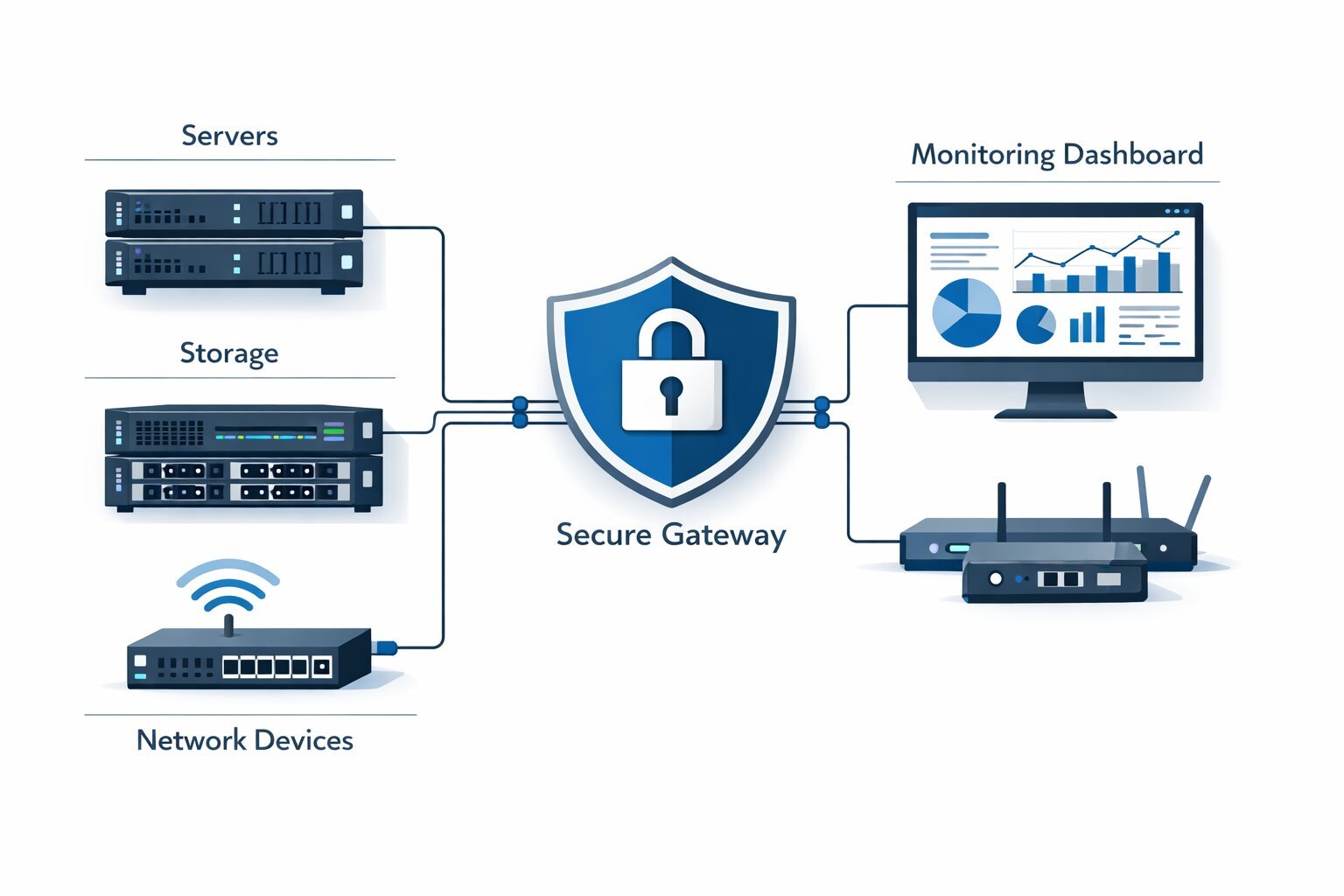
The term Secure Connect Gateway can sound technical and vague at first, especially for readers who are not familiar with enterprise IT systems. Some assume it is just a firewall tool, a VPN feature, or a general secure access product. In reality, it is better understood as a secure support connectivity solution used by organizations to connect important infrastructure systems with a support environment in a controlled and monitored way.
This matters because modern businesses depend heavily on digital infrastructure. Websites, ecommerce stores, internal applications, storage environments, and business systems all rely on stable backend operations. When problems appear in those systems, businesses need faster diagnosis, safer remote support, and better visibility into device health. That is where Secure Connect Gateway becomes useful. It helps create a more efficient support process without turning every issue into a slow manual troubleshooting exercise.
Quick takeaway: Secure Connect Gateway is mainly about secure enterprise support connectivity, proactive monitoring, diagnostics, and faster issue handling for critical infrastructure.
At a Glance
| Topic | Simple Explanation |
|---|---|
| What it is | A secure gateway used for infrastructure support connectivity |
| Main purpose | To improve monitoring, diagnostics, alerting, and remote support workflows |
| Who uses it | Enterprise IT teams, infrastructure teams, support teams, and organizations with managed systems |
| Where it is used | Data centers, server environments, storage systems, networking infrastructure, and virtualized environments |
| Why it matters | It can reduce downtime, speed up support, and improve operational visibility |
What Is Secure Connect Gateway?
Secure Connect Gateway is an enterprise support and monitoring solution designed to help organizations manage communication between their infrastructure and an authorized support environment. It is built for business and IT operations rather than consumer use. Its role is not general web browsing, everyday file sharing, or public website access. Instead, it focuses on support-related workflows such as health monitoring, diagnostics, issue detection, and secure remote assistance.
From a practical standpoint, it works like a controlled bridge. It allows approved systems to send useful operational data, alerts, and diagnostic information in a secure manner. This helps support teams understand what is happening inside the environment without depending entirely on slow, manual exchanges. In many enterprise setups, that difference can save time when a problem affects business continuity.
What Is the Purpose of Secure Connect Gateway?
The main purpose of Secure Connect Gateway is to make infrastructure support more secure, more visible, and more efficient. Instead of waiting for a major problem to be discovered manually, organizations can use it to improve how issues are identified and handled.
A common problem in enterprise IT is that systems often fail silently at first. A storage issue, server warning, or hardware fault may begin as a minor alert but grow into a larger disruption if no one sees it early. Secure Connect Gateway helps reduce that risk by supporting proactive monitoring and issue awareness. That means teams can respond sooner and with better context.
It also helps streamline support workflows. When an issue occurs, the support process usually becomes slower if logs, device details, diagnostic files, or system context are missing. One practical way to approach this is to think of Secure Connect Gateway as a structured support channel. It helps move the right technical information through a secure pathway so that analysis and resolution can happen faster.
Another important purpose is governance. In business environments, remote support cannot be loose or uncontrolled. There must be rules, auditability, and access discipline. Secure Connect Gateway supports that kind of controlled interaction, which is especially important in organizations that care about security, compliance, and internal review processes.
Why Secure Connect Gateway Matters
Businesses today run on connected systems. Even when a company appears to be focused only on websites, SEO, ecommerce, or digital growth, the underlying services often depend on infrastructure that must remain healthy and available. Downtime is not just a technical issue. It can affect sales, customer trust, internal operations, and response times across multiple departments.
Secure Connect Gateway matters because it supports the behind-the-scenes layer that keeps operations stable. It can improve visibility into devices, support earlier issue detection, and make support interactions more structured. In practice, that means less guesswork during incidents and better coordination when something needs urgent attention.
This is particularly useful in environments where teams manage multiple servers, storage systems, networking devices, or virtual platforms. The more complex the environment becomes, the harder it is to handle everything manually. A secure gateway model helps reduce that complexity by centralizing support-oriented connectivity and making technical response more manageable.
Where Secure Connect Gateway Is Used

Secure Connect Gateway is typically used in enterprise and institutional environments rather than on small personal websites or basic home-office setups. It fits best where infrastructure is valuable, uptime matters, and support workflows need to be secure and organized.
Common use environments
| Environment | How Secure Connect Gateway Helps |
|---|---|
| Data centers | Improves monitoring, diagnostics, and support handling for core infrastructure |
| Enterprise server environments | Helps identify hardware or system-level issues faster |
| Storage systems | Supports visibility and issue escalation for critical data infrastructure |
| Networking environments | Assists with secure support coordination for connected systems |
| Virtualized platforms | Helps manage support and operational awareness across shared infrastructure |
| Large organizations with distributed IT | Gives teams a more centralized and controlled support pathway |
For example, a business running multiple critical applications may depend on storage systems, servers, virtualization layers, and network devices at the same time. If one of those layers begins failing, the impact can spread quickly. Secure Connect Gateway helps create a more responsive support model by improving technical communication between the environment and the support side.
How Secure Connect Gateway Works in Simple Terms

Many readers find the concept easier when it is explained in a straightforward workflow.
Basic workflow
- Infrastructure systems are connected to the gateway
The gateway is set up to communicate with supported systems inside the organization’s environment. - Health data and alerts are monitored
The connected environment can surface warnings, status details, and technical information that may help identify issues. - Diagnostic information is made available securely
When support is needed, the relevant system data can be shared through a controlled process rather than through random manual steps. - Support teams respond faster
Because the issue context is clearer, troubleshooting can begin with better information. - Remote support workflows stay governed
Access, logging, and authorization remain important parts of the process, helping reduce security risks.
This does not mean every environment works in exactly the same way. Implementation can vary depending on infrastructure type, security policies, and support requirements. Still, the core idea remains the same: secure, support-focused connectivity that improves operational efficiency.
Key Benefits of Secure Connect Gateway

Secure Connect Gateway offers value mainly through support improvement rather than through marketing or front-end website features. That distinction is important because readers often expect a customer-facing product when they see the word “gateway.”
1. Faster issue detection
One of the biggest advantages is earlier awareness of technical problems. If a warning sign appears in infrastructure, teams may learn about it sooner instead of discovering it only after service degradation becomes obvious.
2. Better diagnostics
Support becomes more effective when the right context is available. Diagnostic information helps reduce blind troubleshooting and shortens the time spent collecting basic technical details.
3. More secure support workflows
A well-designed support connection is better than an improvised one. Secure Connect Gateway is valuable because it is built around controlled communication rather than casual or unstructured access.
4. Reduced manual effort
Without this kind of solution, teams may spend too much time emailing logs, gathering screenshots, explaining system context, or repeating the same incident details. A structured gateway reduces that friction.
5. Improved operational continuity
When important systems are monitored and supported more effectively, the business has a better chance of avoiding long disruptions or unnecessary delays in incident response.
Secure Connect Gateway vs Traditional Manual Support

| Area | Manual Support Approach | Secure Connect Gateway Approach |
|---|---|---|
| Issue discovery | Often reactive | More proactive |
| Data collection | Manual and sometimes incomplete | More structured and support-focused |
| Troubleshooting speed | Can be slower | Often more efficient |
| Security control | Depends on ad hoc processes | More governed and controlled |
| Operational visibility | Limited by manual reporting | Improved through monitored connectivity |
| Scalability | Harder in complex environments | Better suited to larger infrastructure setups |
This comparison matters because many businesses still rely on traditional support habits. They wait for a problem, open a ticket, gather information manually, and lose valuable time. Secure Connect Gateway is designed to reduce that inefficiency.
Real-World Examples of Secure Connect Gateway Use
Example 1: Enterprise data center support
A company running critical internal systems notices performance irregularities in part of its infrastructure. Without a structured support gateway, the internal team would first need to identify the device, collect details, export logs, and escalate the issue manually. With a secure support connectivity model in place, diagnostics and alerts are easier to organize, which helps accelerate the support response.
Example 2: Storage environment issue handling
An organization that depends on high-availability storage cannot afford long troubleshooting delays. If a storage-related warning appears, support workflows need to move quickly and securely. Secure Connect Gateway helps by supporting a monitored and controlled path for operational insight and issue handling.
Example 3: Distributed business IT operations
A large business may have multiple offices, virtual workloads, and interconnected systems. When infrastructure support is spread across teams and locations, inconsistency becomes a real problem. A common issue is that different teams handle incidents differently, leading to delays and poor visibility. A secure gateway helps standardize support connectivity and makes response processes more manageable.
Example 4: Compliance-conscious environments
Organizations with strict internal policies often need remote support processes that are controlled, logged, and clearly governed. In these cases, Secure Connect Gateway is attractive because it aligns better with disciplined support operations than informal remote troubleshooting methods.
Who Should Care About Secure Connect Gateway?
This topic is especially relevant for:
- enterprise IT managers
- infrastructure administrators
- operations teams
- support engineers
- organizations with data center or hybrid infrastructure
- businesses that depend on always-on systems
- companies that want more secure remote support handling
For smaller websites or simple hosting accounts, this may not be a direct purchase or implementation topic. However, from a broader digital operations perspective, it still matters. A business website, ecommerce store, or internal platform can only perform well when the underlying systems are managed properly. That is why infrastructure support topics still connect with website management and technical operations audiences.
Common Misunderstandings About Secure Connect Gateway
“It is just another VPN.”
Not really. A VPN is generally about secure network access between endpoints or users and networks. Secure Connect Gateway is more focused on support connectivity, monitoring, diagnostics, and infrastructure-related service workflows.
“It is for all websites and small businesses.”
Usually, no. It is much more relevant in enterprise or advanced infrastructure environments where there are supported systems that require structured support interaction.
“It only matters when something breaks.”
That is too narrow. Its value also comes from proactive monitoring, earlier detection, and smoother incident handling before problems become severe.
“It replaces all security tools.”
It does not. It should be understood as one part of a larger enterprise operations and security model, not a complete replacement for broader security controls.
Best Practices When Evaluating Secure Connect Gateway
If an organization is considering this kind of solution, a few practical points matter.
Review your infrastructure complexity
The more systems you manage, the more valuable structured support connectivity can become. If your environment is simple, the need may be limited. If your environment is broad and critical, the operational benefits can be much greater.
Understand internal security policy
Before adopting any support connectivity model, teams should evaluate approval workflows, logging requirements, access controls, and internal compliance expectations.
Focus on support efficiency, not just features
A common mistake is evaluating the tool like a normal software purchase with a generic feature checklist. The more useful question is this: will it improve issue detection, diagnostics, and incident response in your real environment?
Plan ownership clearly
From an implementation standpoint, support connectivity should not sit in a grey area between teams. Decide who owns deployment, monitoring, policy review, and ongoing operational use.
Common Mistakes to Avoid
| Mistake | Why It Causes Problems |
|---|---|
| Treating it like a generic remote access tool | Leads to wrong expectations and poor evaluation |
| Ignoring internal security policies | Can create approval and compliance issues |
| Underestimating operational value | Teams may miss the benefit of faster support workflows |
| Assuming it is only useful after a failure | Overlooks proactive monitoring and earlier issue detection |
| Deploying without clear ownership | Creates confusion during actual incidents |
In practice, most mistakes happen because businesses misunderstand the product category. Secure Connect Gateway is not mainly about user access. It is about support readiness, controlled connectivity, and smarter infrastructure operations.
Is Secure Connect Gateway Relevant for a Digital Business Audience?
Yes, but the relevance is indirect for some readers and direct for others.
If your audience includes enterprise IT teams, infrastructure managers, or technical operations professionals, it is directly relevant. If your audience is more focused on websites, SEO, ecommerce, or web development, the topic still has value when framed as part of digital reliability and backend operational continuity.
A high-performing website is never just a front-end success story. It depends on stable systems, reliable infrastructure, and quick issue resolution. Secure Connect Gateway fits into that bigger operational picture. It is one of those technologies that may not be visible to customers, yet it can still influence uptime, support quality, and service continuity behind the scenes.
Final Thoughts
Secure Connect Gateway is best understood as a secure enterprise support bridge rather than a general-purpose connectivity tool. Its purpose is to help organizations improve monitoring, diagnostics, alerting, support workflows, and controlled remote assistance for important infrastructure systems.
For businesses with complex environments, the value is practical. It can help reduce manual support delays, improve visibility into system health, and make incident handling more efficient. For general readers, the simplest way to think about it is this: Secure Connect Gateway helps organizations support critical systems more securely and more intelligently.
6. FAQs
What is Secure Connect Gateway in simple words?
Secure Connect Gateway is a secure support connectivity solution used in enterprise IT environments. It helps organizations connect supported infrastructure systems with a support process in a controlled and efficient way. Its job is not ordinary internet access or browsing. Instead, it focuses on monitoring, diagnostics, alerts, and support workflows.
What is the main purpose of Secure Connect Gateway?
Its main purpose is to improve how technical support is handled for important infrastructure. It helps organizations detect issues earlier, share diagnostic information more efficiently, and make support interactions more structured. This can reduce delays during troubleshooting. It is especially useful in environments where uptime matters.
Where is Secure Connect Gateway used?
It is commonly used in enterprise environments such as data centers, server setups, storage systems, network infrastructure, and virtualized platforms. Large organizations with complex IT operations benefit the most from it. It is generally more relevant for businesses with managed infrastructure than for very small personal websites. The bigger and more critical the environment, the stronger the use case usually becomes.
Is Secure Connect Gateway the same as a VPN?
No, they are not the same thing. A VPN is mainly used for secure network communication or user access between systems and networks. Secure Connect Gateway is more focused on support-related connectivity, diagnostics, monitoring, and issue handling for infrastructure. While both involve secure communication, their purpose and operational role are different.
Who should learn about Secure Connect Gateway?
IT managers, infrastructure teams, support engineers, and operations professionals should understand it most. It is also useful for technical decision-makers who want more reliable and secure support workflows. Even digital business owners can benefit from understanding the concept, especially if their services depend on stable backend systems. Knowing how support connectivity works can help them make better infrastructure decisions.
Does Secure Connect Gateway help with proactive monitoring?
Yes, that is one of its most important advantages. It supports a more proactive approach by helping organizations become aware of technical issues earlier. Instead of depending only on manual discovery, teams can work with a more structured support model. That can improve response speed and reduce the chance of a small issue becoming a major disruption.
Is Secure Connect Gateway only useful when there is a system failure?
No, its value starts before a major failure happens. It is also useful for ongoing monitoring, visibility, diagnostics, and support readiness. A strong support workflow is not only about reacting after something breaks. It is also about being prepared, informed, and able to respond faster when warning signs appear.
What kind of businesses benefit most from Secure Connect Gateway?
Businesses with critical infrastructure, multiple systems, and strict uptime requirements benefit the most. This includes enterprises, institutions, and organizations with data-heavy or service-sensitive environments. It is especially useful where support delays can cause operational or financial damage. Smaller organizations may not always need it in the same way, but larger environments often do.